|
HUMAN & cO. The studio of Dan Cuthbert ART WITHOUT EXEMPTION The Story
The legend of the Great Sachem Cheops Sky Diver
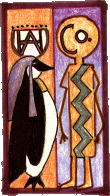
A tomb was found in the upper regions of Ohio that astonished historians the world over. It showed a definite link between the cultures of the Ancient Egyptians and the Native Americans. It was the tomb of the great Sachem (or chief) Cheops SkyDiver (773-805 B.C.). The customs and traditions brought to light at the finding of this tomb added another rich chapter to the history of mankind. Cheops was a benevolent ruler. He ruled over what was at one time considered the middle and lower kingdoms of Mohohio (now Pennsylvania, Indiana, and Kentucky). The capital was somewhere between Cleveland Ohio and Erie Pennsylvania, along the shores of Lake Erie. The tomb was found just north of Akron Ohio in the Cuyahoga Valley area, an area known for it's beauty and spiritual aspects. The main deities honored by these people were the goddess Akissej-Nave, and the guardian Peng-Ra. One of the most surprising things about this Sachem was that he was born blind. It is known that he possessed a profound insight into human nature, and was a man of extreme empathy with a sense of justice. For this his people loved him (though there are records of several occasions which illustrated he was not perfect). Here is a record of his life in brief: Sachem Cheop's parents were Amicus and Esse, Procurers of the Sky, Shaman of what was then an empirical tribe of the people known as the Mohoians. When Cheops was born, the idea that two people, so powerful, could produce an heir who was blind, unnerved the populace. Some took it as a bad sign and tried to use it to change the balance of power. As Cheops grew, he displayed an amount of wisdom and empathy that began to quiet even his harshest opposition. By the time Cheops reached his teenage years, any reluctance to having a blind man assume the reigns of power faded. One of the most noteworthy written stories is of the Sachem's relationship with the goddess Akissej-Nave, and the humility Cheops showed in order to be granted this privilege. Cheop's knew even from youth he was being groomed for the reigns of power. For this he prayed fervently to the goddess for sight. Not because he felt he was being cheated, but because he felt it would help him be a more just ruler. On the other hand the goddess knew Cheops had great insights, and knew to restore his sight would unbalance this. So when he was still a young man, Akissej-Nave appeared to him in a vision. Her compromise was simple. She would not allow him to see with his eyes as most men, the sacrifice would be too great. She allowed him to hear and touch in color, and to see human emotion manifest in his minds eye. Cheops would view the world as no man before him. What Cheops venerated above all was friendship. There is a saying written on the tomb wall, "If I were to die tomorrow, who will explain me?" This was uppermost in the minds of this people. In life you had to create an impression on the memory of those around you, the impression of what you did to enrich their lives. It was only in this way one could be kept alive forever. It was believed by Cheops that the strength of one filled the gap of another. Everyone was dependent. The fact they he remained in power until his death shows not only his strength of independence, but also how those who made up his inner court admired and supported him. In no time of his reign is it reported that anyone tried to usurp his power or his throne. The singing and playing of music was considered to be a protection against evil or harm. The creation of music was the releasing of a part of one's unfathomable spirit to protect and stimulate the good in those around you. Religiously we have a mixture of what made both Egypt and Native Americans great. A great penguin, Peng-Ra, guarded the Sachem. This brings up many other questions about the scope of the kingdom. Those of the Sachem and his inner court were considered divine only in that their guidance affected the entire kingdom. All of the court characters are depicted on the tomb walls as minor deities. As a symbolic gesture , the doors of the various rooms of the palace during the Sachem's reign were placed on the walls of the tomb. Each doorway was believed to depict an entrance into the insights of its particular ruler. Each palace room represented one of these insights. All the doors were buried with each Sachem , and new ones were made for the next administration council. Cheops was also reputed to have been the creator of the Great Tee-Pees, pre-dating the pyramids of Egypt. Three massive stone Tee-Pees were located somewhere in the Cuyahoga Valley. These were erected by Cheops SkyDiver as a resting place for Akissej-Nave, Peng-ra, and those who serve them. It is believed that the tale of Mashtinna the Rabbit stemmed from the life of Sachem Cheops. This, and more will be told later.
Dan Cuthbert 1999 A.C. |